
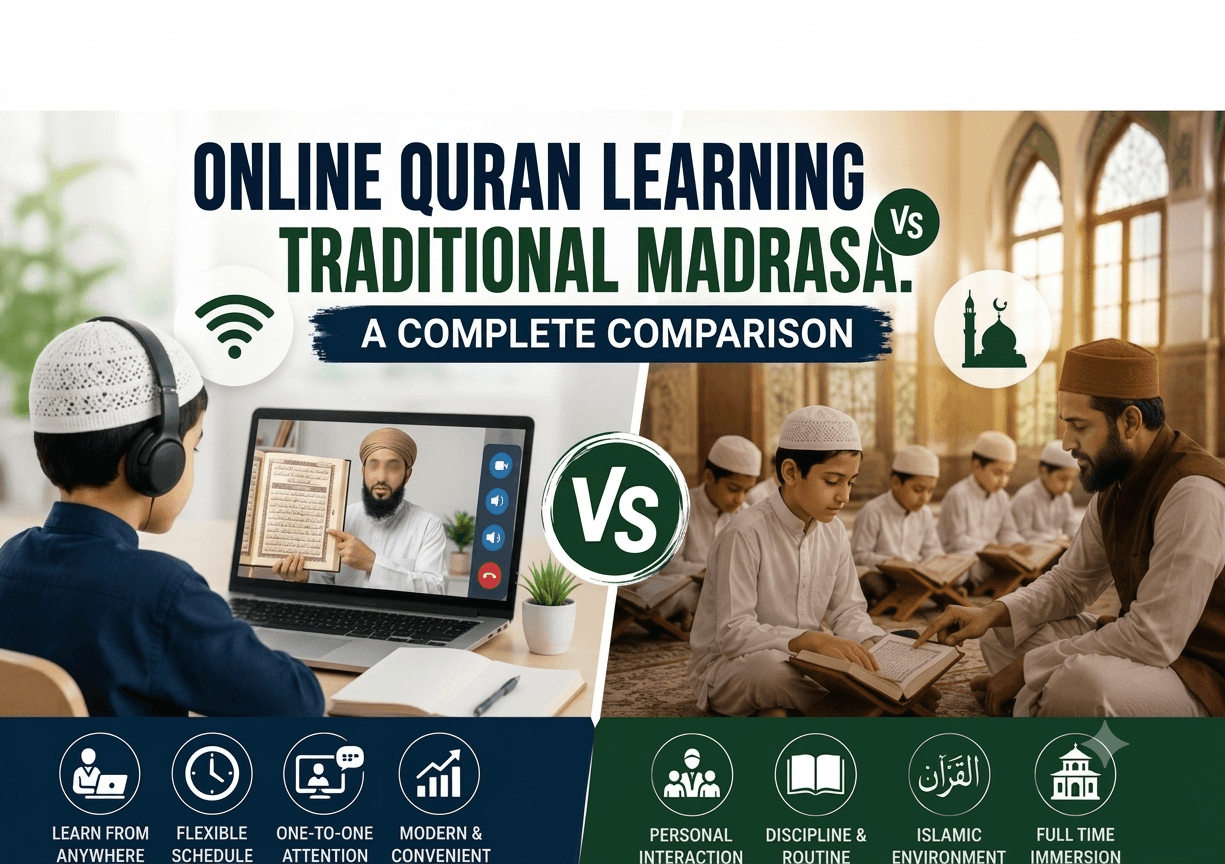
Online Quran Learning vs Traditional Madrasa: Full Guide
Confused between Online Quran Learning and a Traditional Madrasa? This complete comparison breaks down the pros, cons, and best fit for your family's Islamic education goals.
Online Quran Learning vs Traditional Madrasa: A Complete Comparison
Every parent who wants their child close to the Quran eventually asks the same question: should we send them to a traditional madrasa, or is online Quran learning enough?
There is no need to feel torn. Both paths can lead to the same beautiful destination — a heart connected to the words of Allah. But they get there differently, and knowing those differences will help you choose what's right for your family.
Let's walk through it together, the way a teacher would explain it to a student, step by step.
What Is a Traditional Madrasa?
A traditional madrasa is a physical Islamic school where students attend in person, usually following a structured, long-term curriculum. It often includes:
Face-to-face interaction with a teacher (Ustad)
A fixed daily or weekly schedule
A community environment with fellow students
Deep, immersive study of Quran, Hadith, Fiqh, and Arabic
For centuries, this model has produced scholars, huffaz, and devoted students of knowledge. There's a timeless value in sitting physically in front of a teacher (this is called talaqqi), and many scholars consider it the gold standard of learning.
What Is Online Quran Learning?
Online Quran learning connects students with certified tutors through video calls, from anywhere in the world. It typically includes:
One-on-one Tajweed and Quran reading sessions
Flexible scheduling around school, work, or family life
Hifz (memorization) programs with progress tracking
Access to qualified tutors regardless of your location
This method has grown rapidly, especially for Muslim families living in non-Muslim-majority countries, or those with limited access to a nearby madrasa.
Key Differences: Side-by-Side
1. Accessibility
Madrasa: Requires physical presence; limited by geography.
Online: Available anywhere with an internet connection.
2. Flexibility
Madrasa: Fixed timings, less adaptable to personal schedules.
Online: Sessions can be scheduled around your day.
3. Personal Attention
Madrasa: Often group-based classes with divided attention.
Online: Usually one-on-one, allowing focused correction of Tajweed mistakes.
4. Environment
Madrasa: Full immersion in an Islamic environment with peers.
Online: Learning happens at home, requiring some self-discipline.
5. Comfort for Beginners
Madrasa: Can feel intimidating for very young or shy children at first.
Online: Comfortable, familiar home setting can ease early nervousness.
Which One Is Better?
Honestly — it depends on your situation, not on which method is "more Islamic." Both are simply tools to reach the same goal: understanding and reciting the Quran correctly.
Choose a traditional madrasa if:
You have reliable access to a trusted, nearby institution
Your child benefits from in-person structure and peer environment
You're pursuing a long-term scholarly path (Aalim/Aalimah course)
Choose online Quran learning if:
You live far from a authentic madrasa, or outside a Muslim-majority country
You need flexible timing around work, school, or family life
You want personalized, one-on-one Tajweed correction
You or your child need a comfortable starting point before attending in person
Can You Combine Both?
Many families do exactly this. A child might attend a local madrasa for general Islamic studies while taking online Hifz or Tajweed classes from a specialized tutor for focused, individual correction. The two aren't rivals — they can support each other beautifully.
Final Thoughts
At the end of the day, the real goal isn't choosing the "perfect" method — it's making sure the Quran stays present in your life and your children's lives, in whatever form is accessible and sustainable for you.
Online Quran learning has made it possible for families across the globe — from busy cities to remote towns — to connect with certified, qualified tutors and begin their journey with proper Tajweed, one verse at a time.
If distance, time, or access to a trusted madrasa has been holding you back, online learning might be the bridge you need.
Ready to experience it yourself? Book a Free Trial Class at Sanad Quran Academy today to start their journey.